Multi-workspace & git worktrees
Table of Contents
If you run more than one checkout of the same repository — one worktree per feature branch is a common pattern, and coding agents do it almost reflexively — you’ve probably hit a quiet failure mode in code-intelligence tooling: the second checkout’s graph collides with the first. Same file paths, same symbol names, one shared index. This release fixes that at the root: Gortex now tracks each git worktree as an independent repository instance with its own graph, so usages, callers, and resolution stay correctly isolated per checkout.
What shipped #
Each worktree is its own graph instance #
A linked git worktree shares its object store with the main checkout but has a distinct working tree and (usually) a distinct branch. Historically Gortex keyed a repository by a single prefix derived from its directory basename, so two worktrees named oas-orm would both want the prefix oas-orm — and the second one silently coalesced into the first. Their files overwrote each other in the graph, and a find_usages on a symbol in one checkout returned matches from both.
Now a worktree that means to be its own thing gets a derived instance prefix of the form <base>@<tag>, and every node ID it produces is namespaced under that prefix. oas-orm/orm.go::orm and oas-orm@task/orm.go::orm are two different nodes in two different subgraphs. No collisions, no bleed.
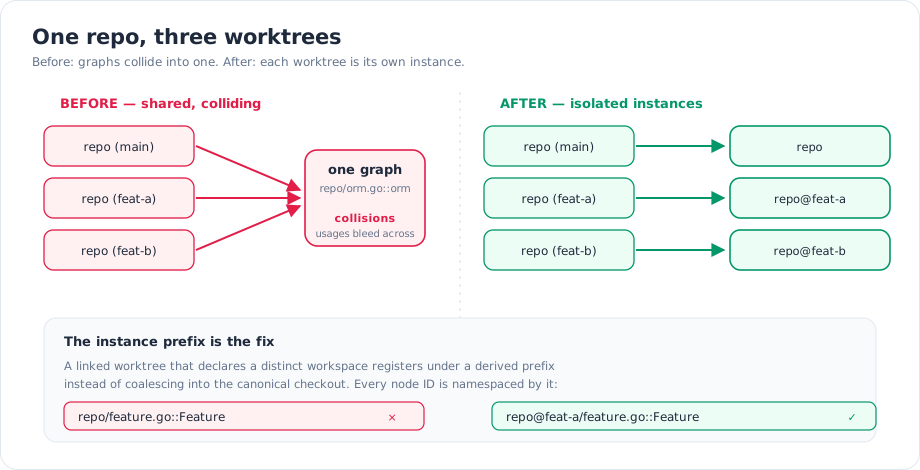
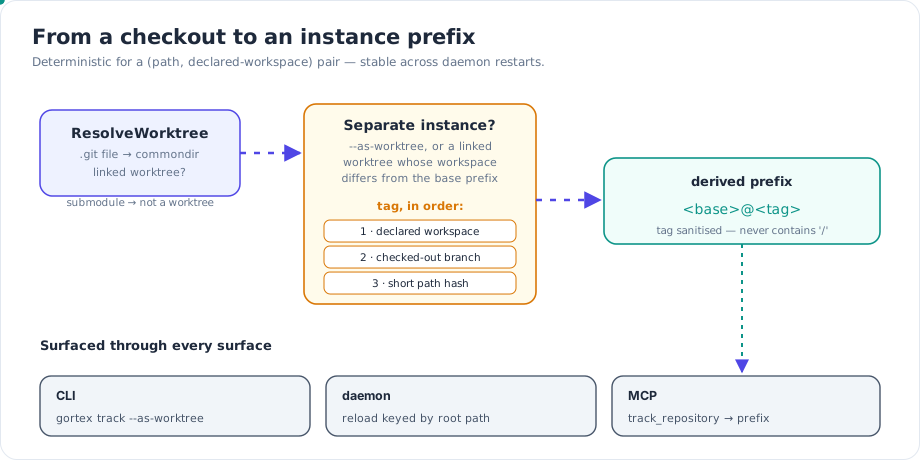
The decision to split is deliberate, not automatic for everything. A worktree becomes a separate instance when either you pass the explicit --as-worktree directive, or it’s a linked worktree whose .gortex.yaml declares a workspace different from its base prefix. The second case is the everyday one: a declared workspace is the signal that this checkout means to live somewhere other than the canonical’s, so Gortex honours it without you asking twice. A plain worktree that declares nothing distinct still coalesces, exactly as before — the new behaviour only kicks in when there’s a real reason to separate.
Surfaced through CLI, daemon, and MCP #
Instancing isn’t an internal bookkeeping detail you can’t see or target. The derived prefix shows up everywhere you’d track or address a repo:
- CLI —
gortex trackresolves the same instance rule the daemon does, including the--as-worktreeflag for a forced split. - Daemon — tracked instances appear in metadata under their derived prefix, and config reload preserves them (more on the mechanics below).
- MCP —
track_repositoryon a worktree path returns the derived prefix in its response, so an agent knows exactly which instance it just registered and can target it in later calls.
How it works: deriving a stable prefix #
The split happens in two steps. First, ResolveWorktree figures out whether a path even is a linked worktree. A linked worktree carries a .git file (gitdir: <path>) rather than a directory; the referenced per-worktree gitdir holds a commondir file pointing back at the shared .git. A git submodule also uses a .git file but has no commondir, so it correctly resolves to itself — a submodule is a separate repository, not a worktree. A main checkout (a .git directory) and a non-git directory both resolve to themselves too.
Second, when a separate instance is warranted, the prefix tag is chosen in a fixed priority order:
- the declared workspace from the worktree’s
.gortex.yaml, if it differs from the base prefix; - otherwise the checked-out branch name (detached HEAD has none, so it’s skipped);
- otherwise a short, stable hash of the path — the last-resort disambiguator so two checkouts that share everything else still get distinct prefixes.
The tag is then sanitised: a repo prefix is the leading <prefix>/ segment of every node ID, so the token must never contain a /. Any character outside [A-Za-z0-9._-] is folded to -. The whole derivation is a pure function of (path, declared-workspace), which means it’s deterministic across daemon restarts — a fresh index over the same config reproduces the same instance prefixes, with no dependence on a persisted name or on the order in which repos were tracked.
A nice side effect of overlapping prefixes (oas-orm and oas-orm@task-ws) is that path resolution disambiguates them by longest match: a prefixed graph path maps back to exactly one checkout on disk, never the wrong one.
How it works: three correctness fixes that keep instances honest #
Splitting the graph is only half the job. Three supporting fixes make sure the split holds up across the daemon’s lifecycle.
Warm-restart reconcile is keyed by the instance. Gortex comes back from a restart by diffing persisted file mtimes against disk and reconciling only what changed. Because a worktree instance is its own tracked entity — with its own root path, its own branch, its own IsWorktree flag in metadata — that reconcile runs per instance. A worktree’s branch-only files reconcile against the worktree, not against the canonical that happens to share a basename.
The daemon matches reload diffs by root path, not by recomputed prefix. When you edit the config file directly and the daemon reloads, it has to decide which tracked instances are still wanted and which to untrack. The trap: a worktree registered as oas-orm@task-ws, but config.ResolvePrefix on its entry would recompute the bare basename oas-orm. Keyed on the recomputed prefix, the reload would fail to recognise the instance as wanted and untrack it on every reload. So the diff is keyed on the absolute root path instead — the stable identity of a checkout — and a no-op reload leaves both the canonical and the worktree instance untouched.
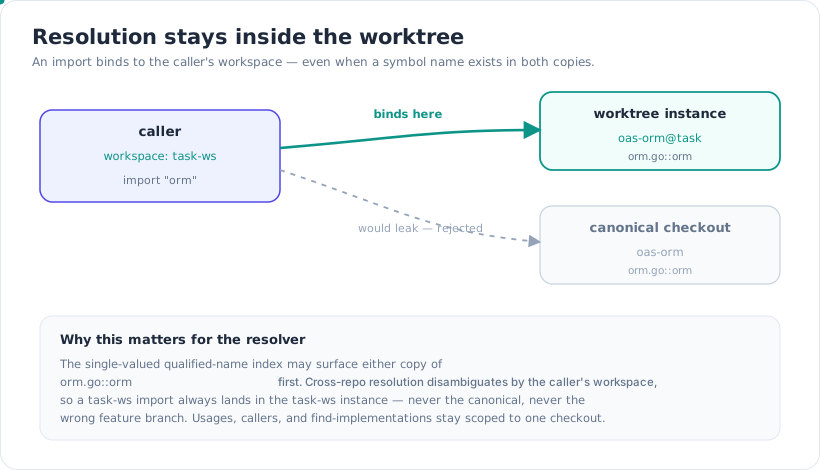
Imports bind to the caller’s worktree workspace. This is the resolution fix, and it prevents the subtlest leak. When two checkouts both define orm.go::orm, the single-valued qualified-name index can surface either copy first. Cross-repo resolution disambiguates by the caller’s workspace: an import from a task-ws caller binds to the oas-orm@task instance, and a base-workspace caller binds to the canonical — regardless of which copy the name index happened to return. Resolution never leaks across worktrees.
Try it #
The whole feature is driven by ordinary paths, config keys, CLI flags, and MCP tools — there’s no new subsystem to learn.
- Declare a workspace on the worktree. Drop a
.gortex.yamlin the worktree’s root withworkspace: <name>. If that name differs from the base prefix, the linked worktree is tracked as an independent instance automatically. - Force a split explicitly.
gortex track --as-worktree <path>registers a worktree as its own instance even when it declares no distinct workspace — the tag falls back to the branch, then a path hash. - From an agent. Call the MCP
track_repositorytool with the worktree’s path. The response carries the derived<base>@<tag>prefix; use it to scope later calls (search_symbols,find_usages) to that one checkout. - Restart freely.
gortex daemon restartreconciles each instance from its own persisted mtimes, and a plain config reload preserves your worktree instances because it matches by root path.
Each instance behaves like any other tracked repo: its prefix scopes search, its metadata records IsWorktree and the real root path, and a session launched from inside the worktree resolves to that worktree’s workspace rather than the canonical’s.
Why it matters #
Multiple worktrees of one repo is how a lot of real work gets done — and how coding agents parallelise across feature branches without stepping on a shared tree. The moment your tooling can’t tell those checkouts apart, its answers stop being trustworthy: a usage search returns matches from the wrong branch, an impact analysis double-counts, an agent edits against a graph that’s a blend of two working trees. Per-worktree instancing removes that ambiguity at the source. Keep ten worktrees of the same repository if you like; their graphs, their usages, and their resolution stay correctly, deterministically isolated.
Part of the Gortex May–June 2026 release series.