LLM providers & graph-aware routing
Table of Contents
Every coding agent eventually needs a model to call: to expand a fuzzy search query, to rerank candidates, or to run a multi-hop research question across a codebase. The wrong default here is expensive in two directions — pinning everyone to a single hosted endpoint costs money and lock-in, while pinning everyone to a local model caps quality. Gortex’s answer is to make the model a configuration choice, not a code dependency: point it at whatever you already pay for, and let the graph decide when a task is worth a more capable model.
This article covers the engine behind two features that need an LLM — the ask research agent and assisted search (search_symbols with assist: modes) — and the routing layer that sits in front of them.
What shipped #
One interface, nine backends #
Internally there is exactly one thing the rest of Gortex depends on: an llm.Provider with a Complete() method. A single factory, provider.New(cfg), reads your configuration and returns the concrete backend you selected. Nothing above that line — the agent loop, assisted search, the MCP tool wrappers — knows or cares which model is behind it.
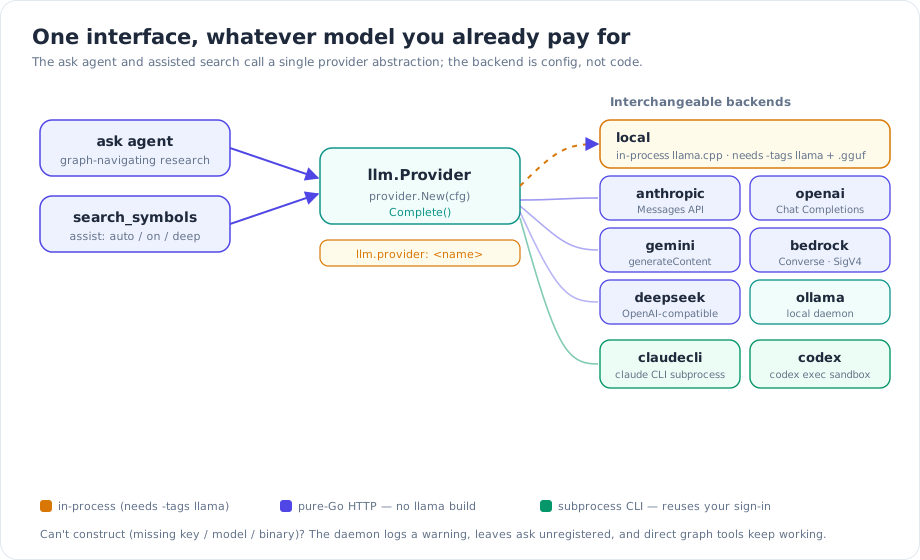
You pick a backend with llm.provider in .gortex.yaml or your user config. The released set:
local(the default) — an in-process llama.cpp model. This is the one backend that needs a-tags llamabuild and a.ggufpath inllm.local.model.anthropic— the Messages API. Needsllm.anthropic.modelandANTHROPIC_API_KEY.openai— Chat Completions. Needsllm.openai.modelandOPENAI_API_KEY.ollama— a local Ollama daemon. Needsllm.ollama.model(and optionallyllm.ollama.host).gemini— Google’sgenerateContentREST API. Needsllm.gemini.modelandGEMINI_API_KEY.bedrock— the AWS Bedrock Converse API, signed with SigV4. Needsllm.bedrock.model_idand AWS credentials (plus an optional session token); the region defaults tous-east-1.deepseek— DeepSeek’s Chat Completions endpoint (OpenAI-compatible). Needsllm.deepseek.modelandDEEPSEEK_API_KEY.claudecli— theclaudeCLI driven as a subprocess. No API key: it reuses your existing Claude Code subscription onceclaudeis on$PATHand signed in.llm.claudecli.modelis optional.codex— the OpenAIcodexCLI as a subprocess, runningcodex execin a read-only sandbox. It reuses your Codex / ChatGPT sign-in.
The important structural fact: everything except local is pure Go. The HTTP providers and the subprocess providers build and run without the -tags llama toolchain. So a machine that can’t (or doesn’t want to) compile the llama.cpp C bindings can still run the agent against Anthropic, OpenAI, Gemini, Bedrock, DeepSeek, Ollama, or one of the CLI subprocesses — no CGo required.
Structured output, per provider #
The agent and assisted search need structured responses (the model has to return JSON the engine can parse), and not every API exposes the same machinery for that. Rather than lowest-common-denominator everything, each provider adapts:
- Gemini uses
responseSchema— but Gortex stripsadditionalPropertiesfrom the schema first, because Gemini rejects it. - Bedrock forces a
respondtool: structured output falls out of a tool call the model is required to make. - DeepSeek has no strict
json_schemamode, so it usesresponse_format: json_objectplus a schema hint injected into the system prompt.
These are not user-visible knobs; they’re the per-backend translation that lets one calling convention sit above nine different wire protocols.
Graph-aware routing #
A single model for every request is a blunt instrument. “Who calls NewServer?” and “trace how a request flows from the web tier’s stats endpoint through the contract to the downstream handler and everything it touches” are not the same size of problem — but a flat default pays the same price for both.
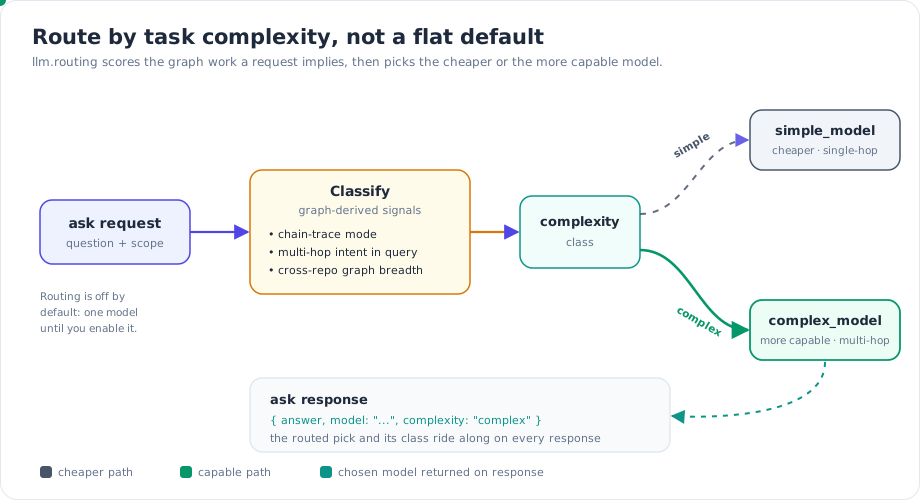
llm.routing (off by default) fixes that. When you enable it, the ask agent is dispatched to one of two models based on how much graph work the request implies. Configure three keys: routing.enabled, routing.simple_model, and routing.complex_model.
How it works: scoring the graph work, not the prose #
The word “graph-aware” is load-bearing. The classifier doesn’t just look at how long your question is — it scores the shape of the graph traversal the request is likely to demand. The signals are cheap to gather (no extra LLM call), and they describe how far across the graph the agent will have to reach:
- Chain-tracing mode. A cross-system call-chain request (consumer → contract → provider → downstream) is inherently multi-hop, so it pushes hard toward the complex class.
- Multi-hop intent in the question. Phrasing like trace, blast radius, every caller, end-to-end, or refactor signals work that spans many nodes, not a single lookup.
- Cross-repo graph breadth. An unscoped run over a multi-repo workspace has to reason over a wider slice of the graph than one narrowed to a single repo by a
repo/project/reffilter.
Each signal contributes to a score; above a threshold the request is classified complex and goes to complex_model, otherwise it’s simple and goes to simple_model. A trivial single-hop lookup runs on the cheaper model; a cross-system trace or a refactor-scale question earns the more capable one.
The decision isn’t hidden. The chosen model and the complexity class ride back on the ask response — model is the routed pick, and complexity is "simple" or "complex" (set only when routing is enabled). You can see, per call, which model answered and why it was picked.
How it works: a missing key never breaks the daemon #
Provider construction is best-effort by design. At startup the daemon resolves your config and tries to build the selected provider. If it can’t — a missing model or API key, local without a -tags llama build, claudecli / codex without the binary on $PATH, or bedrock without AWS credentials — it doesn’t crash and it doesn’t error out your session. It logs a warning, leaves the ask tool unregistered, and moves on.
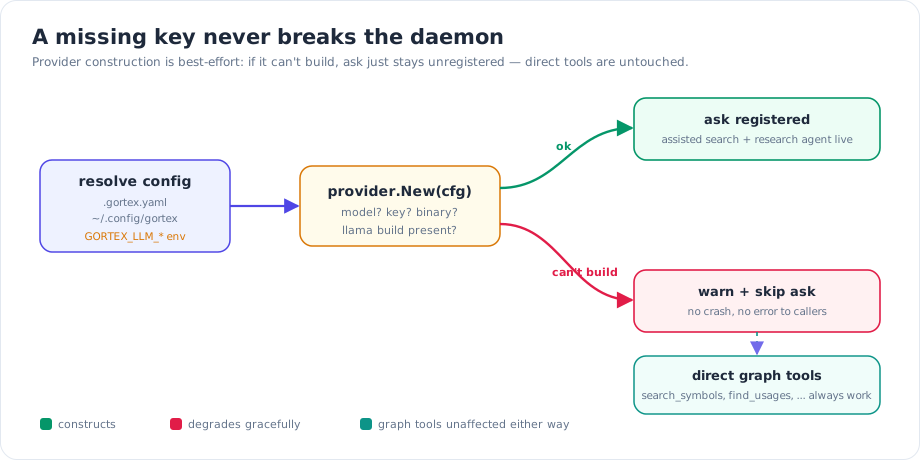
The payoff: the direct graph tools — search_symbols, find_usages, get_callers, and the rest — have no LLM dependency and keep working regardless. Misconfigured the model? You lose the research agent, not the engine.
Try it #
Pick a provider in .gortex.yaml (or ~/.config/gortex/config.yaml). A hosted example, no llama build required:
llm:
  provider: anthropic
  anthropic:
    model: <your-model>   # + ANTHROPIC_API_KEY in the environment
Reuse a CLI you’ve already signed into — no API key at all:
llm:
  provider: claudecli     # needs `claude` on $PATH, signed in once
Turn on graph-aware routing:
llm:
  provider: anthropic
  routing:
    enabled: true
    simple_model: <cheaper-model>
    complex_model: <more-capable-model>
Override without touching the file — handy for a one-off or CI — via environment variables like GORTEX_LLM_PROVIDER and GORTEX_LLM_MODEL, which target the active provider’s model field.
Then use it. The ask MCP tool runs the research agent on whatever you configured:
ask question: "trace how /v1/stats reaches the gortex handler" chain: true
With routing enabled, that response carries its model and complexity fields. And assisted search is the same engine in a different shape — search_symbols takes an assist: mode of auto (the default — engages on natural-language queries, skips plain identifier lookups), on (force it), off (pure BM25), or deep (adds a body-grounded verification pass). When no provider is configured, the assist modes simply behave as off.
Why it matters #
Models change monthly, prices change, and the right model for a one-line lookup is rarely the right model for a cross-repo trace. By collapsing every backend behind one interface, Gortex turns “which model” into a line of YAML instead of a build decision — and by scoring the graph work a request implies, routing spends a capable model only where the traversal earns it. You point the engine at the model you already pay for; the graph decides when it’s worth more.
Part of the Gortex May–June 2026 release series.
← A much better teammate for coding agents · ↑ Series overview · A rebuilt storage & performance layer →