A much better teammate for coding agents
Table of Contents
Autonomous coding agents lose almost everything they learn. A context window fills up and gets compacted; the next session starts cold; a sub-agent forks off with the wrong tools; an edit lands that doesn’t even parse. Gortex already gives an agent a queryable graph of your code — this cycle’s work is about turning that graph into a teammate: one that remembers, coordinates, and edits carefully over MCP. The throughline is that none of this is a prompt trick. Each capability is backed by graph state and a real MCP tool.
What shipped #
Two layers of memory #
The single most expensive failure mode for a long-running agent is forgetting why it made a call. The diff records what changed; the reasoning evaporates the moment the context window compacts. Gortex now has two distinct memory layers, and the distinction between them is the whole point.
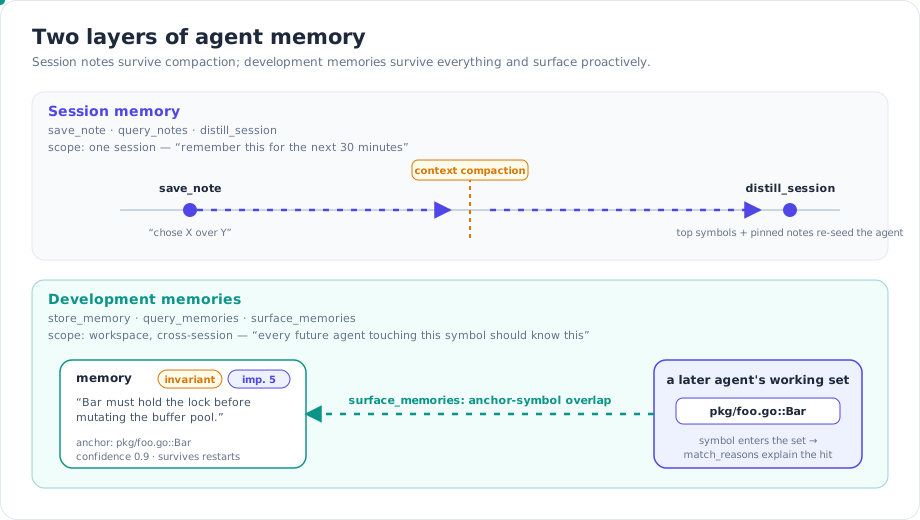
Session memory vs. development memory — two different lifetimes, two different audiences.
Session memory — save_note, query_notes, distill_session — is a per-session scratchpad. When an agent picks an approach, rejects an alternative, or discovers a non-obvious constraint, it writes a note. Mention a symbol or file in the body and the note is auto-linked to that node in the graph. The defining property: these notes survive a context compaction. When the window is squeezed and the agent’s working memory is gone, distill_session returns the top symbols, pinned notes, decisions, and recent excerpts from earlier in the same workspace — enough to re-seed the agent’s mental model before it touches a single file. Think of it as “remember this for the next thirty minutes.”
Development memories — store_memory, query_memories, surface_memories — are the opposite scope. They are workspace-wide and cross-session. They survive daemon restarts, agent swaps, and team rotation. Each memory carries a kind (invariant, constraint, convention, gotcha, decision, incident, or reference), an importance from 1 to 5, and a confidence from 0 to 1. The honesty of those fields matters: invariant means “violating this breaks the system,” gotcha means “an agent will get this wrong without warning.” This is “every future agent touching this symbol should know this.”
The two are complementary, not redundant. A session note is for future-you in this session; a development memory is for every future agent in this workspace. The longer a team uses Gortex, the more the second layer compounds.
Memories that surface themselves #
The mechanism that makes development memories more than a passive store is surface_memories. It isn’t a lookup you remember to perform — it’s proactive. When an agent assembles its working set for a task (the symbols and files it’s about to touch), surface_memories ranks the memory store against that set and returns the relevant ones. Ranking blends anchor-symbol overlap, file overlap, task-keyword hits, importance, pinning, recency, and confidence. Each returned memory carries match_reasons — ["symbol:pkg/foo.go::Bar"] is direct evidence that this memory applies to your working set, not a vague semantic guess.
In the diagram above, a later agent pulls pkg/foo.go::Bar into its working set; the anchor overlap lights up the stored invariant (“Bar must hold the lock”) and the memory surfaces before the agent edits anything. When a memory stops being true, store_memory supersedes it: the old entry stays in the store for audit but is hidden from future surfacing. History is never deleted — only superseded.
Agents that can see each other #
A single agent is the easy case. Real workflows fan out: a planner spawns workers, an editor runs a sub-agent, two agents touch the same package. For that to be safe they have to be able to coordinate.
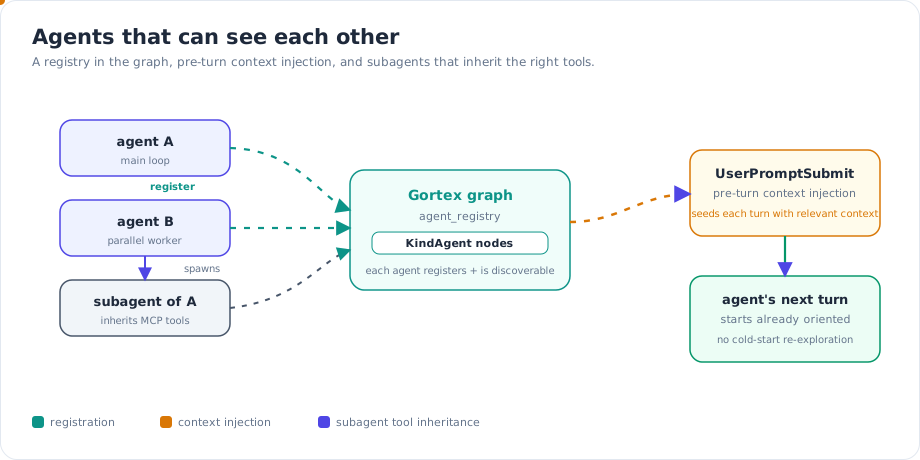
The coordination registry: agents as first-class graph nodes, plus pre-turn context injection.
Coordination is built on three pieces. First, an agent_registry MCP tool backed by KindAgent nodes in the graph — agents are first-class, registrable, discoverable graph citizens rather than anonymous connections. Second, UserPromptSubmit pre-turn context injection: before a turn runs, the relevant context is seeded into it, so the agent starts already oriented instead of cold-starting its exploration every turn. Third, sub-agent MCP-tool propagation — when an agent spawns a sub-agent, the sub-agent inherits the right tools. This is documented and tested, not incidental: a sub-agent shouldn’t silently lose access to the graph tools its parent relied on.
Edits you can actually review #
An agent that edits code over MCP is only as trustworthy as its edit path. A blind Write that overwrites a file is a liability. This cycle hardened the edit surface around a single principle: see the change before it lands, and catch a bad one the instant it does.
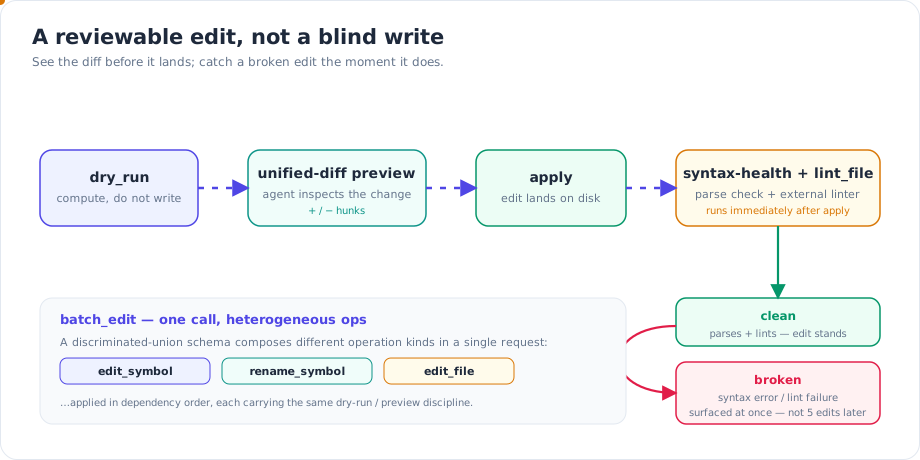
The edit pipeline: preview before apply, verify right after.
edit_symbol gained a dry_run mode, and the edit tools now return unified-diff previews — the same +/− hunk format a human reviewer reads — so the agent (or the human watching it) can inspect exactly what will change before committing to it. batch_edit got a discriminated-union schema, which lets heterogeneous operations compose in one atomic call: an edit_symbol, a rename_symbol, and an edit_file op can ride together, applied in dependency order. And after an edit lands, a post-edit syntax-health check runs, with an external-linter bridge via lint_file. A bad edit — one that breaks the parse or fails the linter — is surfaced immediately, at the edit that caused it, instead of five edits and three tool calls later when the failure mode is unrecognizable.
Smaller niceties that remove friction #
Two ergonomic fixes that matter in practice. The search tools now accept pattern as an alias for query, so an agent that reaches for the “wrong” parameter name still gets an answer instead of a schema error. And an orphan watchdog closes the MCP proxy when its parent process dies — no more zombie proxies lingering after the agent that spawned them is gone.
How it works: anchor-symbol surfacing #
It’s worth being precise about why surface_memories is different from “ask the LLM if it remembers anything relevant.” The graph already knows the symbols and files in the agent’s working set as concrete node IDs. A development memory stores its anchor symbol IDs the same way. Surfacing is therefore a structural match over node identity first, then a ranked blend — not a fuzzy embedding similarity that hallucinates relevance. That’s what makes match_reasons honest: when a memory comes back tagged symbol:pkg/foo.go::Bar, it’s because the exact anchor symbol is in your working set right now. The ranking signals only reorder a set that is already structurally relevant; they don’t conjure relevance out of nothing. The result is that a high-importance invariant anchored to a function you’re about to edit shows up before you edit it, with a reason you can verify.
Try it #
These are real MCP tool names and config keys, usable today.
Session memory (per-session, survives compaction):
save_note tags:"decision" body:"chose X over Y because Z — pkg/foo.go::Bar" pinned:truequery_notes symbol_id:"pkg/foo.go::Bar"— before editing a symbol you’ve touched beforedistill_session— first thing after a compaction or at session start in a touched repo
Development memories (cross-session, workspace-wide):
store_memory kind:"invariant" body:"Bar must hold the lock before mutating the pool" symbol_ids:"pkg/foo.go::Bar" importance:5 pinned:truesurface_memories task:"<task>" symbol_ids:"<top hits from smart_context>"— right after assembling your working setstore_memory id:"<new>" supersedes:"<old-id>" body:"<corrected fact>"— when a memory is no longer true
Coordination:
agent_registry— register and discover agents (KindAgentnodes)- UserPromptSubmit injection and sub-agent tool propagation are wired into the agent configuration Gortex generates
Safe edits:
edit_symbol ... dry_run:true— compute the diff without writingbatch_edit— composeedit_symbol/rename_symbol/edit_fileoperations in one calllint_file— the external-linter bridge invoked by the post-edit health check
Adjacent capabilities worth knowing. Overlay sessions let an editor extension push unsaved buffers as a per-session shadow graph; this cycle they gained branching and parallel speculative sessions — fork an overlay (overlay_fork), explore down a branch, then keep or drop it (overlay_drop). And artifacts — non-code knowledge files like DB schemas, API specs, and ADRs declared in .gortex.yaml — are indexed as artifact nodes and linked to the code that implements them via reference edges, so an agent can navigate from a spec to its implementation.
Why it matters #
Each of these is small on its own. Together they change what an agent is in this codebase. It remembers its reasoning across a compaction, inherits hard-won invariants from agents that ran weeks ago, coordinates with its peers as graph citizens, and edits behind a preview-and-verify gate instead of a blind write. The knowledge compounds: the store gets richer, the surfacing gets sharper, and the next agent starts further ahead than the last. That’s the difference between a tool an agent calls and a teammate it works with.
Part of the Gortex May–June 2026 release series.
← Deeper analysis · ↑ Series overview · LLM providers & graph-aware routing →