Deeper analysis
Table of Contents
Some of the most useful questions about a codebase don’t map to a single function. Where could this secret leak? What is the real hot path? Is this Java symbol actually dead? Answering them usually meant grepping, reading call sites by hand, or reaching for an external tool. This release pushes that work into the graph: a new interprocedural bottleneck analyzer that sees computation cost compounding across call boundaries, and a set of first-class capability edges that turn “what touches this secret” into a one-hop query.
What shipped #
The analyze tool has always been a unified dispatcher — you pass a kind and it routes to one of many analyzers rather than exposing a tool per analysis. With this release it’s a 60-kind surface. Two additions matter most here: a bottlenecks kind that reasons interprocedurally, and three new capability edges that are now real, traversable parts of the graph.
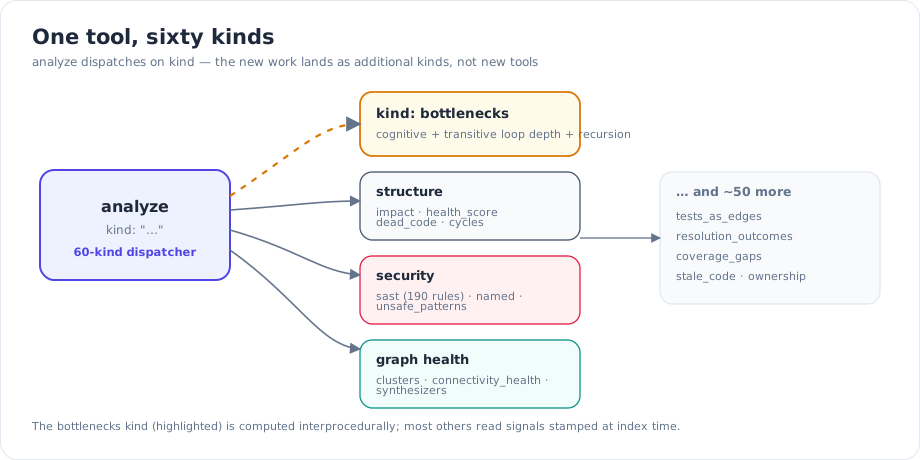
analyze dispatcher: new analysis lands as additional kinds, not new tools.
Interprocedural complexity and bottleneck scoring #
Per-function complexity metrics — cyclomatic count, cognitive complexity, the deepest loop nest inside one function — are easy to compute and easy to fool. A function with a single for loop looks cheap. The problem is that the loop calls another function that loops, which calls a third that loops again. No single function is alarming; the composition is cubic.
analyze kind=bottlenecks is built to catch exactly that. For each symbol it surfaces the per-function metrics that are stamped at index time (cyclomatic, cognitive, the local loop depth) and then adds the signals that only make sense across the call graph:
- Transitive loop depth — how deep the loop nesting actually gets once you follow calls. A loop in
Athat callsB(which loops) that callsC(which loops) has an effective depth of three, even though each function reads as depth one in isolation. This is the signal that exposes hiddenO(n^k)hot paths. - Unguarded recursion — functions that recurse without an obvious base-case guard, which is the other classic way a “small” function turns into an unbounded cost.
These roll up into a single bottleneck score per symbol, with reasons attached so you can see why a symbol scored high — whether it was cognitive complexity, accumulated loop depth, recursion, or a combination.
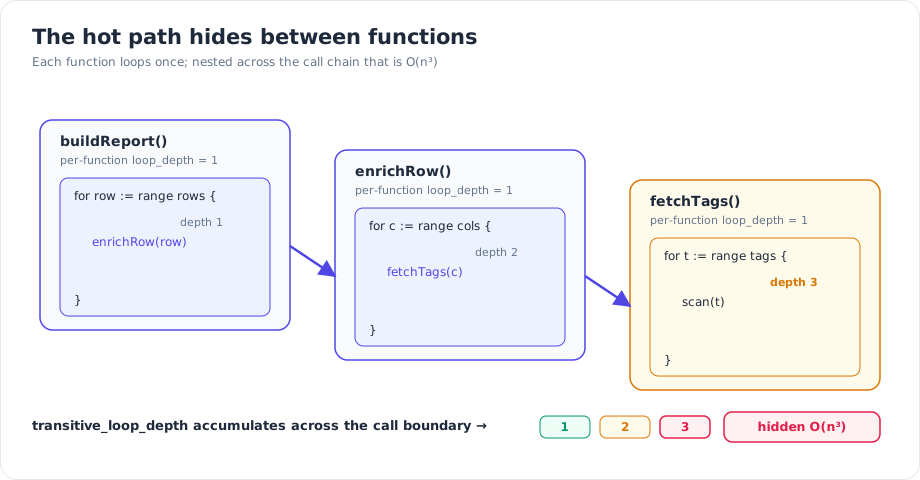
O(n³) — which per-function metrics miss entirely.
Capability edges: reads_env, executes_process, accesses_field #
The second addition changes what kinds of questions the graph can answer at all. Three new edge kinds are now first-class members of the graph:
reads_env— a function reads an environment variable (parallel to how config reads are already modeled, but targeting an env key).executes_process— a function calls a known process-execution API, pointed at a command — i.e. it shells out.accesses_field— a function reads or writes a struct field or class member. The edge carries the access mode, so “who writes this field” and “who reads it” are distinguishable.
Because these are genuine edges — not a report you regenerate, not a text-search heuristic — they live in the same traversable graph as call and type edges. A least-privilege or supply-chain audit becomes a single hop:
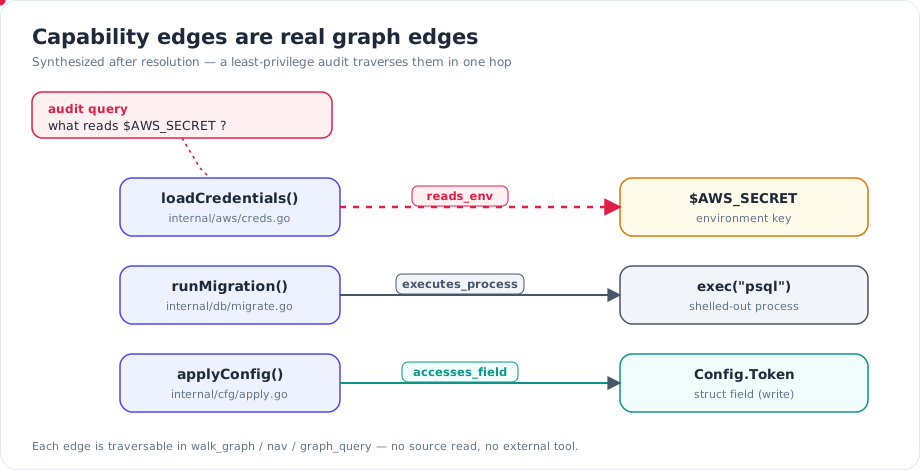
$AWS_SECRET?” is now one edge traversal — no source read, no external tool.
The animated path above is the point: asking “what reads $AWS_SECRET” lights up every function with a reads_env edge into that key, directly. The same shape answers “what shells out” (follow executes_process) and “what writes this field” (follow accesses_field with the write mode).
Java reaches parity #
Three structural analyzers that used to be Go-grade now work as well on Java: dead-code detection, entry-point detection, and process analysis. The key word is visibility-aware — these analyzers respect Java’s access modifiers and entry-point conventions rather than leaning on Go-shaped heuristics. So “is this Java symbol actually dead?” gets a real answer instead of a false positive driven by a name-matching guess.
How it works #
The capability edges are synthesized after resolution. Gortex first parses and resolves the graph, so that call targets and field accesses are settled — then a post-resolution pass derives the capability edges from the base edges that are already there. An executes_process edge is synthesized from a call into a known process-exec API; an accesses_field edge is synthesized from every resolved read/write edge that lands on a field, stamped with its access mode; a reads_env edge mirrors the existing config-read machinery but targets an environment key.
Two properties make this safe to rely on. First, the synthesis is idempotent: edges are deduplicated by key, and a reindex re-derives them from the current base edges rather than appending duplicates. Second — and this is what makes them usable in a live agent loop — they are refreshed on incremental reindex. When you edit a file, the capability edges for the affected symbols are re-derived along with everything else, so the answer to “what reads this secret” stays correct as the code changes underneath you, not just at full-index time.
The bottleneck analyzer works the other way around. The cheap per-function metrics (cyclomatic, cognitive, local loop depth) are computed once and stamped onto each node at index time, so they’re already sitting on the graph. The expensive interprocedural part — walking the call graph to accumulate transitive loop depth and to spot unguarded recursion — is computed when you run analyze kind=bottlenecks, on top of those stamped signals. You pay the graph-walk cost only when you ask the question.
Try it #
Both capabilities live on the MCP surface — the analyze dispatcher and the graph-traversal tools.
Score the interprocedural hot paths with the analyze tool and kind: "bottlenecks":
{ "kind": "bottlenecks", "path_prefix": "internal/", "min_score": 1 }
Each row carries cyclomatic, cognitive, loop_depth, transitive_loop_depth, recursive, a composite score, and the reasons behind it. Filters are path_prefix, kinds (default function,method), min_score, and limit.
The capability edges are traversable wherever you query the graph — the walk_graph, nav, and graph_query surfaces. The edge kinds are exactly reads_env, executes_process, and accesses_field. A least-privilege audit is a traversal that starts at an env key and follows reads_env inbound, or starts at a function and follows executes_process / accesses_field outbound to see everything it can touch. Because the edges refresh on incremental reindex, the same query is valid against a working tree you’re actively editing.
For the broader picture, the same analyze dispatcher carries the other security and structural kinds — sast (a 190-rule, CWE/OWASP-tagged scan across eight languages), impact (a composite change-risk score), health_score (a per-symbol A–F grade), plus clusters, connectivity_health, tests_as_edges, synthesizers, and resolution_outcomes. They share one tool and one mental model: pick a kind.
Why it matters #
The throughline is that questions which used to live outside the graph now live inside it. “Where could this secret leak” was a grep plus careful reading; it’s now an edge traversal. “What is the real hot path” needed a profiler or a hunch; it’s now a graph walk that sees cost compound across call boundaries. “Is this Java symbol actually dead” produced false positives from name heuristics; it’s now a visibility-aware analysis. For a human that’s faster. For a coding agent — which can’t eyeball a call chain or skim a file the way you can — turning these into one-hop graph queries is the difference between getting a reliable answer and guessing.
Part of the Gortex May–June 2026 release series.
← Many more languages — and file types · ↑ Series overview · A much better teammate for coding agents →